No data team? No problem.
Download our free guide to learn how to handle overwhelming data requests, practice your communication skills, and prioritize your professional development as your nonprofit's data team of one.
Download our free guide to learn how to handle overwhelming data requests, practice your communication skills, and prioritize your professional development as your nonprofit's data team of one.
.jpg)
There are certain terms and phrases that we love to use in the nonprofit sector: empowerment, sustainability, growth, and my personal nemesis, impact (that’s another blog for another day!). In fact, these types of words appear in our goals so often that they sometimes lose their meaning. Unfortunately, if we’re not clear on what we mean when we use more conceptual terms, that becomes a big problem from an evaluation perspective.
To effectively measure our successes and know definitively whether we’re achieving our goals, nonprofit leaders must operationalize their constructs in order to:
But how do we get a consensus about the meaning of concepts when they’re so open to interpretation? To see how this works in practice, let’s use an example from my favorite sleep-paralysis demon, the fundraising gala, to demonstrate this point.
(Ask me about my gala trauma in the comments!)
--------------------------------------------------------------------------------------------------------------------------------------
Let’s pretend for a moment that our development team has set the following goal for 2026:
Host a successful fundraising gala in FY2026 that raises $50k.
While it’s great that this goal has a measurable outcome (raising $50k), there are other ways that a gala can be successful in the short, medium, and long-term. For instance, “success” can mean:
So how can the team clarify what it means by a “successful fundraising gala?”
The process for defining our concepts needs to begin well before the first registration form goes out. Defining fundamental concepts sets the course for the rest of the program, policy, or event we’re trying to evaluate. In this case, defining success for the fundraising gala should be the first step in the planning process.
We tend to think of the audience for our events as our attendees, and this is obviously an essential group. We want to make our guests as happy as possible so they leave with a positive impression of the organization. But what does a successful gala look like from the perspective of the staff and volunteers? What about from the ED’s or board’s perspective? Are there other groups that we should consider talking to when it comes to defining success, like specific donors or foundations? Brainstorming the different audiences that might have an opinion about what success means can help the team come to a more nuanced definition of the term.
Once the team has brainstormed the list, it’s time to ask the audiences for their understanding of success. This can happen in two different ways:
For instance, the ED might tell you that success means raising that $50k and nothing else. Meanwhile, the major gifts officer defines success by the number of follow-up donor meetings that happen after the event, and the event coordinator believes success means no one cried over a slight misspelling on their name tag (not like I’ve been there or anything!). Get the perspectives of all of the stakeholders and incorporate their thoughts accordingly.
After speaking with stakeholders, the team might learn that there are multiple types of success when it comes to the fundraising gala, including:
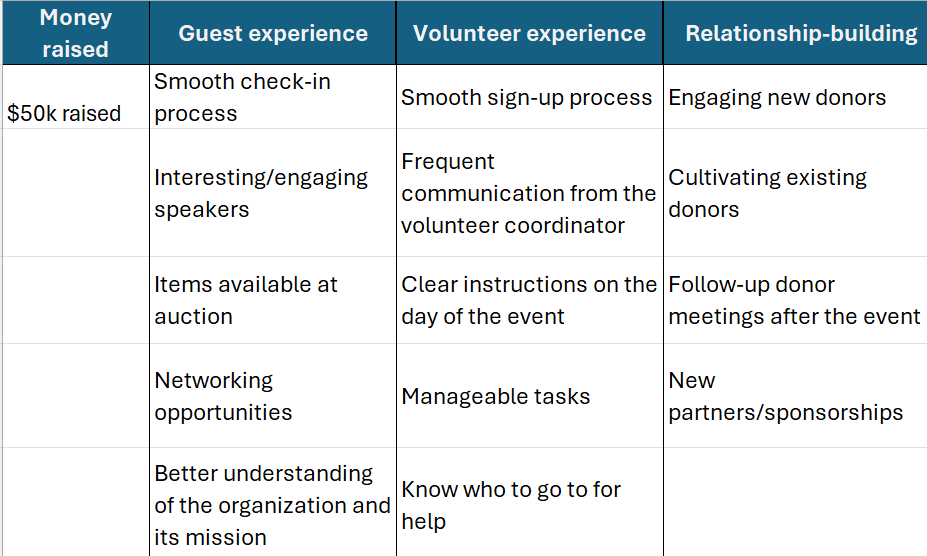
Now, with these more specific definitions in mind, the team can incorporate these measures of success into a planning document, logic model, or other type of evaluation plan. From there, the team can create action steps and evaluation tools to ensure that they meet this more comprehensive definition of success. And instead of using just one metric to define success, there are now many ways that the team can tell the story of their most important event of the year.
Defining your constructs isn't just a philosophical exercise; it's the foundation of meaningful evaluation. When your team agrees on what success, impact, or sustainability looks like before the planning and implementation work begins, you're moving beyond setting goals. Now, you’re building the framework that will let you tell a richer, more honest story about your organization's impact.
There are certain terms and phrases that we love to use in the nonprofit sector: empowerment, sustainability, growth, and my personal nemesis, impact (that’s another blog for another day!). In fact, these types of words appear in our goals so often that they sometimes lose their meaning. Unfortunately, if we’re not clear on what we mean when we use more conceptual terms, that becomes a big problem from an evaluation perspective.
To effectively measure our successes and know definitively whether we’re achieving our goals, nonprofit leaders must operationalize their constructs in order to:
But how do we get a consensus about the meaning of concepts when they’re so open to interpretation? To see how this works in practice, let’s use an example from my favorite sleep-paralysis demon, the fundraising gala, to demonstrate this point.
(Ask me about my gala trauma in the comments!)
--------------------------------------------------------------------------------------------------------------------------------------
Let’s pretend for a moment that our development team has set the following goal for 2026:
Host a successful fundraising gala in FY2026 that raises $50k.
While it’s great that this goal has a measurable outcome (raising $50k), there are other ways that a gala can be successful in the short, medium, and long-term. For instance, “success” can mean:
So how can the team clarify what it means by a “successful fundraising gala?”
The process for defining our concepts needs to begin well before the first registration form goes out. Defining fundamental concepts sets the course for the rest of the program, policy, or event we’re trying to evaluate. In this case, defining success for the fundraising gala should be the first step in the planning process.
We tend to think of the audience for our events as our attendees, and this is obviously an essential group. We want to make our guests as happy as possible so they leave with a positive impression of the organization. But what does a successful gala look like from the perspective of the staff and volunteers? What about from the ED’s or board’s perspective? Are there other groups that we should consider talking to when it comes to defining success, like specific donors or foundations? Brainstorming the different audiences that might have an opinion about what success means can help the team come to a more nuanced definition of the term.
Once the team has brainstormed the list, it’s time to ask the audiences for their understanding of success. This can happen in two different ways:
For instance, the ED might tell you that success means raising that $50k and nothing else. Meanwhile, the major gifts officer defines success by the number of follow-up donor meetings that happen after the event, and the event coordinator believes success means no one cried over a slight misspelling on their name tag (not like I’ve been there or anything!). Get the perspectives of all of the stakeholders and incorporate their thoughts accordingly.
After speaking with stakeholders, the team might learn that there are multiple types of success when it comes to the fundraising gala, including:
Now, with these more specific definitions in mind, the team can incorporate these measures of success into a planning document, logic model, or other type of evaluation plan. From there, the team can create action steps and evaluation tools to ensure that they meet this more comprehensive definition of success. And instead of using just one metric to define success, there are now many ways that the team can tell the story of their most important event of the year.
Defining your constructs isn't just a philosophical exercise; it's the foundation of meaningful evaluation. When your team agrees on what success, impact, or sustainability looks like before the planning and implementation work begins, you're moving beyond setting goals. Now, you’re building the framework that will let you tell a richer, more honest story about your organization's impact.

Take our free Data Audit Checklist quiz to evaluate your current data practices and discover immediate improvement areas.
Take The Quiz